
Source-reviewed components
Ballot cryptography
Exponential ElGamal over Ristretto255, homomorphic addition and threshold-combination code exist. Source presence is not proof of a fully secured election pipeline.
Assessment only. Not yet suitable for any live election. Deployment and operation require authorized SparkGlim Security and Technical Teams.
SparkGlim SEVA · Pre-release
Explore SEVA’s source-reviewed design for locally hosted, supervised elections. It remains pre-release and is not yet suitable for any election.
Separate responsibilities. Validate the complete path.
Security depends on the complete implementation, trusted operations and reviewed evidence. No certification or independent audit is claimed.
Formal elections have a different operating model.
Explore SEVA’s intended Master and Kiosk model, local election services, data separation and incomplete verification boundary.
Explore SEVASparkGlim Awards & Digital Voting has its own campaigns, nominees and checkout journey. SEVA is assessed separately for supervised institutional elections.
SparkGlim Awards & Digital VotingSEVA addresses controlled election operations. Public awards, paid nominee voting and fundraising use other SparkGlim products.
The architecture separates configuration, eligibility checks, ballot marking, authority operations and evidence review. Each boundary needs integration testing.
Core cryptographic components exist in source. Artifact-proof and tally verification remain incomplete; architecture diagrams are not end-to-end assurance.
SparkGlim Security and Technical Teams alone authorize operational access. A consultation does not approve deployment or make SEVA election-ready.
Understand SEVA’s implemented ballot-encryption and trustee primitives, and the verification work still required before election use.
How sealed configuration, hash-linked records, signatures and replay controls support SEVA’s intended integrity model.
Review SEVA’s intended identity and ballot separation, blind eligibility credentials, retention considerations and privacy limitations.
Evaluate SEVA’s device, operator, transport and recovery boundaries before planning a supervised election environment.
Process
Agree governance, locations, eligibility and evidence requirements with the authorized teams.
Separate administration, check-in, kiosk, trustee and monitoring responsibilities.
Resolve eligibility, duplicate records and supervised exceptions before participation.
Review contests, candidates, ordering and permitted selections with the election authority.
Opening is a supervised authority decision after readiness review, not a public launch button.
The intended kiosk journey separates a cast ballot from a ballot opened for audit.
Review turnout and operational alerts; keep candidate totals outside the polling view.
Stop participation and reconcile paper, device and operational evidence under the authority’s procedure.
Trustee and tally components support the intended post-close process. Complete independent verification remains unfinished.
Agree custody, retention, observer access and recovery responsibilities before any proposed deployment.
Pre-release
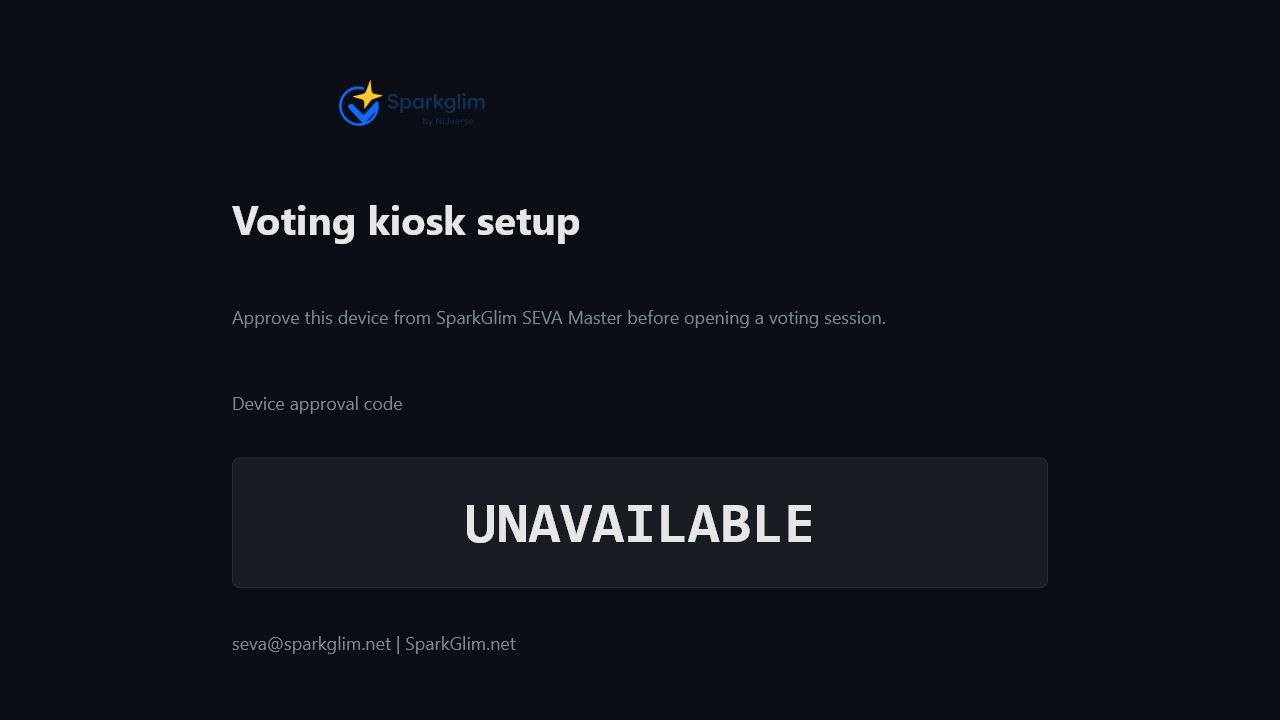
The kiosk is part of a supervised election design. Current source and screenshots do not establish a released, election-ready application.
Institutions
An assessment scenario, not an approved deployment.
Assess student representation elections through roll preparation, ballot review and supervised participation.
Prepare a requirements discussion for organization elections without mixing them with fundraising or public popularity votes.
Assess controlled internal elections with clear authority, eligibility and evidence responsibilities.
Assess education-sector representation elections through authority, controlled operations and accessible review.
Assess association and membership-body elections with clear roll ownership and supervised participation.
Assess operational and governance needs across locations without implying remote internet voting or regulatory approval.
Current readiness
Source review confirms that a component exists. It does not establish independent security assurance, completed deployment tests or approval to run an election.
Source-reviewed components
Exponential ElGamal over Ristretto255, homomorphic addition and threshold-combination code exist. Source presence is not proof of a fully secured election pipeline.
Source-reviewed components
Chaum–Pedersen proofs, primitive selection-sum checks and distributed-key-generation components have source tests. These tests were not executed during this website audit.
Source-reviewed components
Blind credential issuance and spent-nullifier storage are implemented in source. Complete voter identity, reissue and concurrent check-in assurance still requires integration testing.
Source-reviewed components
The core state machine restricts transitions and disallows egress in Open and Paused. Actual session, ceremony and network enforcement must be validated together.
Source-reviewed components
Role-scoped database grants and hash-linked audit/ballot components support the intended separation of duties. Host trust, custody, logs and recovery remain part of the threat model.
Integration testing required
The artifact verifier does not yet complete integrated ballot-proof and tally checks. Do not treat a verifier result as complete election assurance.
Integration testing required
Authentication adapters, signing and hardware-key modules exist, but their full operational integration is unfinished. No universal FIDO2, non-exportable HSM custody or biometric guarantee is claimed.
Integration testing required
Hardware lockdown, printing and custody, recovery, integrated mock elections and external review require acceptance evidence. Runbooks and module names are not certification.
Planned or under development
The two-installed-application direction is proposed. Current source packaging still contains several surfaces and executables; released two-app deployment is not established.
Planned or under development
Shuffle-based processing and ranked/write-in scenarios remain deferred. A feature flag or roadmap entry does not establish a supported cryptographic protocol or ballot type.
Request consultation
Assessment only. Not yet suitable for any live election. Deployment and operation require authorized SparkGlim Security and Technical Teams.
Country context guides the consultation. It does not establish jurisdictional approval, regulatory compliance or product availability.